
Stop copying. Start winning.
Munich Security Conference unwind: The diplomats have now less power than technological companies.

The Munich Security Conference used to be where decisions got made. Foreign ministers, heads of state, quiet conversations in corridors. That world still exists. But it’s becoming a theater.
The real decisions — on what gets built, how fast, and for whom — are now made by a different cast. As warfare has become fundamentally technological, it’s the private innovation sector that holds the leverage, not diplomats. Victory is won by who can innovate and mass-produce.
Resilience: same word, completely different meanings
MSC was framed around resilience. Everyone agreed on the word. No one agreed on what it means.
The US wants to remain unchallenged as a global power — and frames resilience as independence from China at any cost. This is what’s driving the push for Chinese-free components in drone supply chains that I wrote about last month.
Europe’s version of resilience is less about China and more about the US. For the first time, European governments are asking uncomfortable questions about what happens if Washington is no longer a reliable partner. China is even now more popular in Denmark than the US.
The answers are producing some odd outputs: a rush of companies are now trying to replicate US equipment, but make them American free. The most recent examples, was French government ditching Zoom for a home-grown alternative that no one heard about, Visio. A wave of European companies explicitly positioning themselves as “Palantir/Starlink/Saronic for Europe”.
But Europe isn’t monolithic. Germany’s posture is fundamentally different. Berlin still sees the US as an ally — and feels the urgency of rearmament too acutely to wait for domestic alternatives to mature. The question for them isn’t “how do we build sovereign infrastructure over the next decade.” It’s “what can we field now”. This makes sense when you consider that in the most recent NATO exercises, 10 Ukrainian soldiers using drones defeated two whole battalions of NATO troops and 17 armoured vehicles in a single day. Whatever we have in stock today wouldn’t last a week in a real conflict.
This tension — between the luxury of strategic autonomy and the urgency of immediate capability — will define European defence investment for the next five years.
What would European independence actually require?
The honest answer is not more European Palantirs.
Look at the US. The US would be in a very different place without its technological prowess of the past 20 years. Today, growth and stock market is driven by some version of the Magnificent Seven: without Alphabet, Amazon, Apple, Meta, Microsoft, Nvidia, Tesla and Palantir, the US would be much less a global power. On the contrary, Europe would be a in much better position with these 7 home-grown companies.
Europe’s path to genuine independence doesn’t run through copying what already exists. It runs through out-innovating it. Not a Palantir for Europe — a more ambitious version of what Palantir could be, so much more performant and interoperable that it displaces the original globally. Not a European Anduril — a company that makes Anduril look like a legacy prime in ten years.
That’s a higher bar. But it’s the only one worth aiming for.
Some companies here are definitely choosing this path: Frankenburg is going full speed on building better, cheaper missiles, starting with interception. Destinus or Harmattan are on track to make more revenues outside of Europe than within - showing that superior products don’t need to play the sovereignty card and to stay within national borders.
Ukraine’s industry shows what true resilience looks like
One thing MSC made unmistakably visible: Ukrainian defence companies now have serious commercial clout. On the resilience part, Ukrainian companies are not playing the card of being a European alternative to X. They boast amazing product specs, price points and speed of iteration that is unmatched.
UForce had one of the most prominent presences — a full booth, steady traffic, and serious deal conversations around their USVs and drones. These aren't unknown products: their Magura USV became famous for sinking Russian warships in the Black Sea.
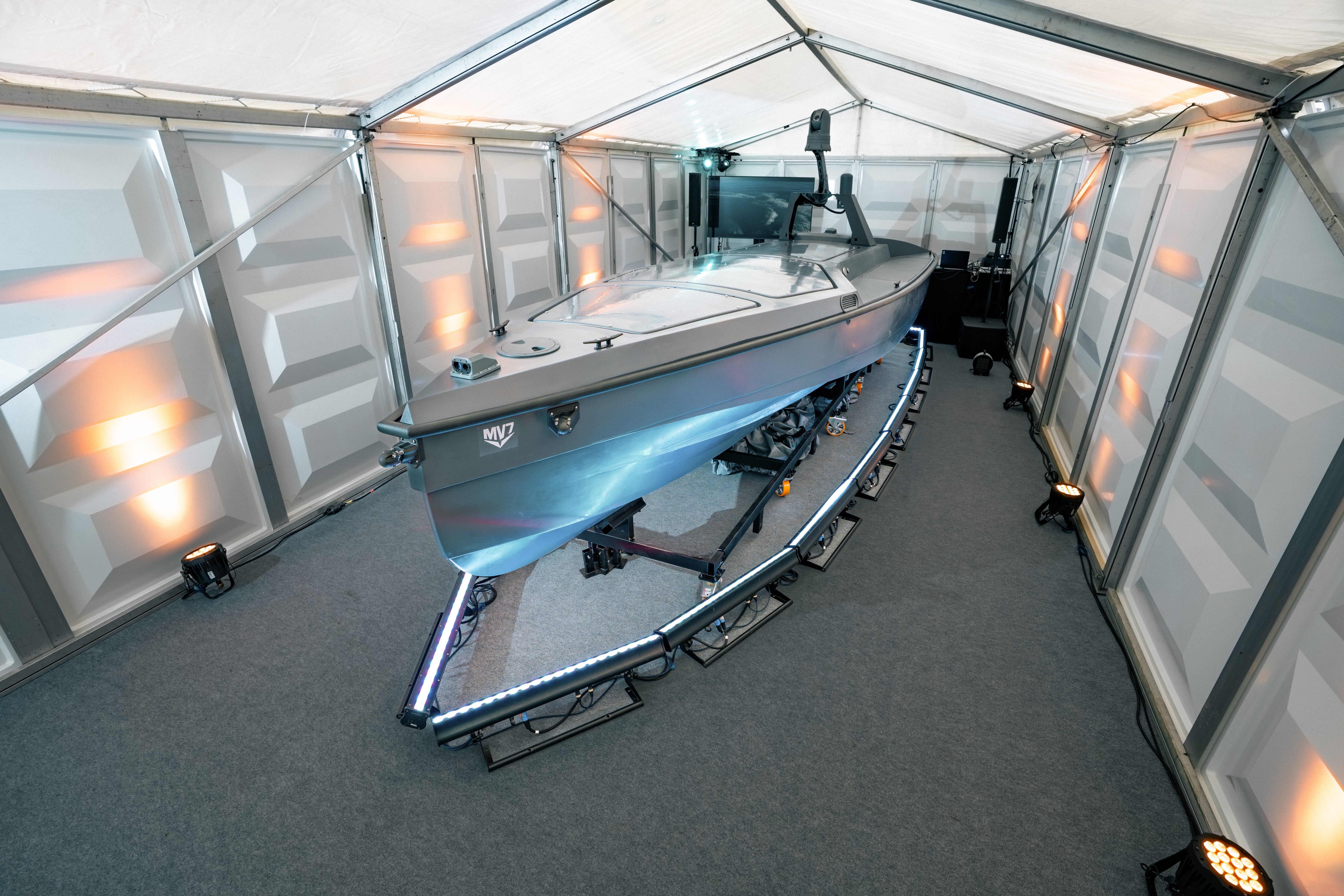
The companies that built systems under fire will carry structural advantages that outlast the conflict itself. That’s not a temporary edge. That’s a moat.
Fundraisings:
Skyryse – Automated flight control systems for helicopters and aircraft, raised $300m Series C with Autopilot Ventures and Fidelity Investments.
Machina Labs – AI-driven metal manufacturing platform for defense and aerospace, raised $124m Series C with Lockheed Martin Ventures and Woven Capital.
Stark - building loitering munition drones- has become the newest European defense unicorn, backed by Sequoia.
Overland AI – Autonomous ground vehicle systems for military logistics and reconnaissance, raised $100m with 8VC.
MASNA Ventures – Saudi Arabia’s first defense-focused VC fund targeting drones, precision munitions and AI-enabled systems, is raising at least $100m for its inaugural fund.
Radicl – Cybersecurity provider for defense and critical infrastructure SMBs, raised $30m Series A with Paladin Capital Group.
Apeiron Labs – Autonomous underwater robots, raised $9.5m.
Uplift360 – Regeneration of high-value composite materials for aerospace and defence supply chains, raised $8.7m Seed with Extantia and NATO Innovation Fund.
Galadyne – Missile manufacturing startup redesigning missile production, raised $4.8m Pre-Seed with Andreessen Horowitz and Pax Ventures.